![A banner image for a website promoting a positive and fulfilling lifestyle, with the theme "Just live the good life" and a tag line "You live only once but if you do it right, once is enough" capturing the essence of living life to the fullest and embracing joy and happiness in a modern and uplifting design. [Incorporating vibrant and uplifting colors] [With modern and sleek typography] [Featuring images that evoke joy and happiness] [Representing a sense of vitality and energy]](https://justlivethegoodlife.in/wp-content/uploads/2024/07/img-heipnmflzhjispl3gwey7csb.png)
One of the most interesting insights from Yin and Yang is that every strength carries the seed of its opposite. Yin and Yang come from ancient Chinese philosophy, which explains how seemingly opposite forces are actually complementary and interconnected.
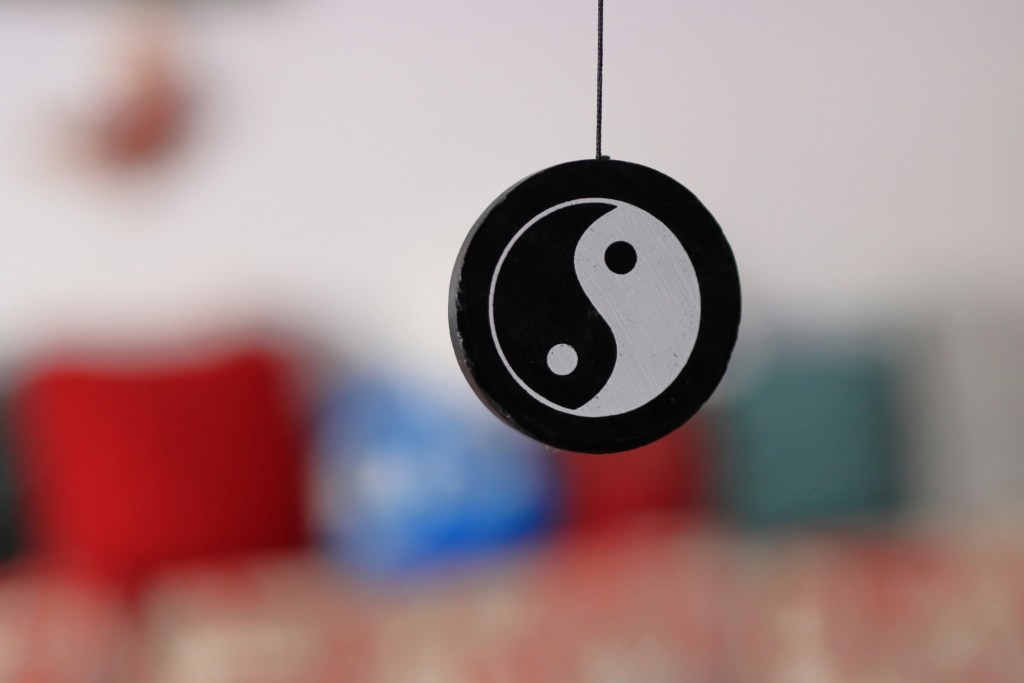
Instead of seeing the world as good vs bad or strong vs weak, Yin-Yang teaches that balance between opposites creates harmony.
In leadership, this happens all the time.
– Decisive leaders can become impatient.
– Detail-oriented leaders can become controlling.
– Visionary leaders can lose operational focus.
– Collaborative leaders can struggle to make tough calls.
The Yin-Yang idea reminds us that overusing a strength eventually turns it into a liability.
Great leaders don’t just build strengths. They learn when to dial them down. This perspective is powerful because it reframes leadership development:
It’s not always about adding more skills. Sometimes it’s about balancing the ones you already have.
The Hidden Half of Leadership:
The Yin-Yang symbol also highlights something leaders often forget which is half of the work is invisible.
What we see are decisions, strategies presentations and execution.
What we don’t see (the Yin side) is reflection, listening, thinking through second order consequences or observing team dynamics.
In fast moving organizations, leaders sometimes over index on visible output. However, the quiet work behind the scenes is often what determines whether those decisions succeed.
The best leaders create space for thinking, not just doing.
The Cycle of Momentum:
Another powerful lesson from Yin-Yang and ideas is that every phase eventually transforms into its opposite.
– Expansion leads to consolidation.
– Growth leads to stabilization.
– Action leads to reflection.
This is especially relevant for fast-scaling organizations and GCCs. Many teams struggle because they try to operate permanently in growth mode.
Sustainable progress happens in cycles.
Build → Stabilize → Improve → Scale again
Leaders who understand this rhythm avoid burnout, poor decisions, and rushed transformations.
They know when to push momentum, and when to protect stability.
 Justlivethegoodlife